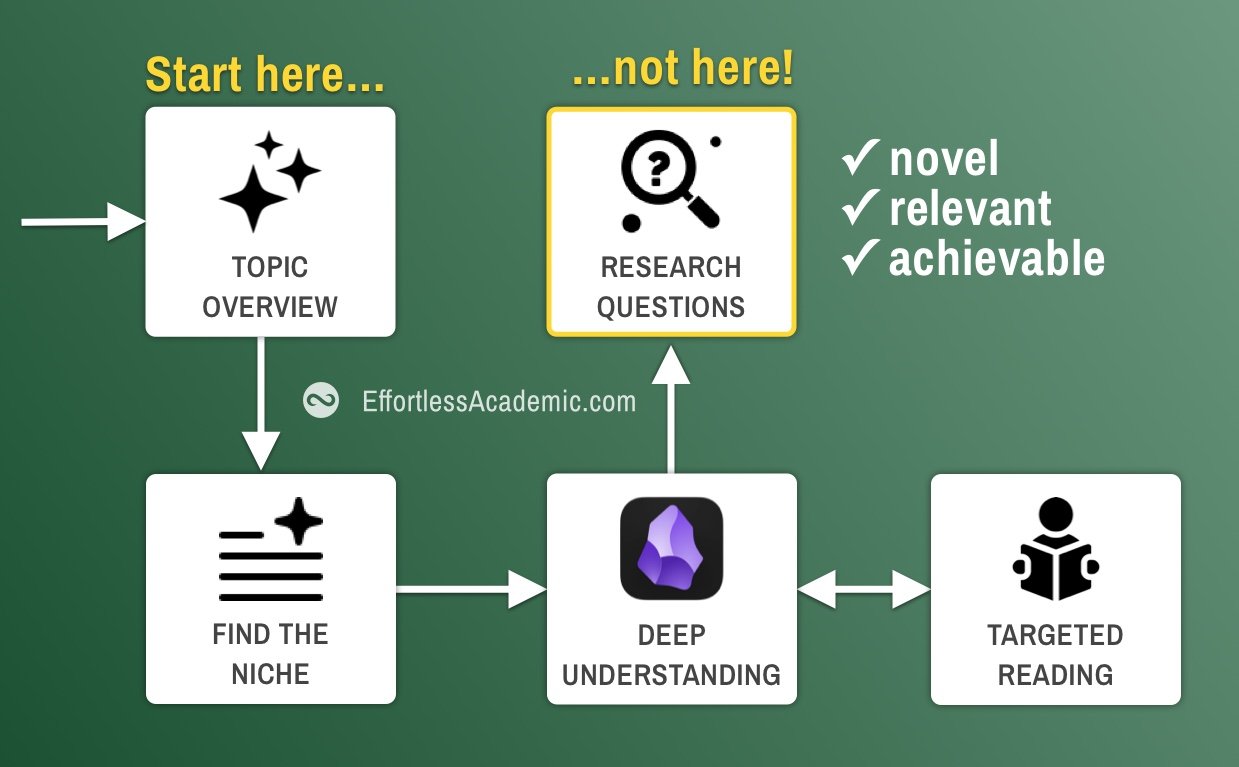
Most advice on literature reviews starts with “Define a research question” or “Select a topic”. This is backwards. You will ask the wrong questions if you don’t know anything about a topic. Instead, start with a high-level understanding of a field, then move to a niche, and once you fully understand it, the questions will be apparent. In this post, we will examine strategies and tools to use for the best possible literature review.
Learn which tools can speed up your research: This free 21-day email series introduces you to a range of academic tools and how they work together to speed up the time needed for a literature review. Most of these tools have been around for less than a few years, some use AI. Knowing them gives you an almost unfair productivity advantage for your research.
While it is true that you need good research questions for a literature review, you don’t start with them. Good questions are a consequence of good research. When I started a PhD in ecology, I had no formal training and spent the first six months looking for a good PhD question. It is not that I had no ideas; I came up with the wrong ideas and asked the wrong questions! Every week, my supervisor would smash down my research proposals because they were irrelevant, trivial or not connected to the big picture. It was a frustrating time, to say the least.

But this process taught me a process I use for all of my research now: Understand a topic before you ask questions about it. While “understanding a topic” might sound like a lot of work, AI can augment it. Here is the process:
- Aim to build an overview understanding, but ignore the nitty-gritty details. AI can significantly accelerate this process.
- Identify a niche that excites you, is relevant, and that you can contribute to using whatever funds/time/energy are available to you.
- Build a deep understanding of this niche with all its details. The more narrow the niche, the less there is to learn. Focus on the essentials.
- Target your reading towards identifying research questions. Read papers with the unknown in mind.
Doing it in this order allows you to ask research questions that are:
- Valid and interesting
- Relevant to the advancement of science
- Achievable
This strategy is part of my literature review course. Try it for free at the link below.

Step 1: Building a Topic Overview
I use two ways to build an overview of a topic: The classical review method and the AI-based method. You can combine and compare these methods for yourself.
The classical review method
The easiest way to understand a topic is to read the best review you can find on it. Somebody did what you are doing and presented the result here. Of course, your literature review can’t be a copy of theirs, so you will need to synthesize multiple reviews and add new advancements to do it well. So, how do you find good reviews?
The easiest way is to throw 3-4 papers on your topic into Litmaps, ResearchRabbit or ConnectedPapers and let the tools discover the entire bibliography around this topic. This will result in many more papers than you can (or should) read. To not get overwhelmed identify impactful review papers by the number of references and citations. If a paper has many references and citations (and is not too old), it is exactly what you are looking for!

You can sort by references using your reference manager (Get the Scite plugin for Zotero) or Litmaps (as shown in the screenshot). Pick just a few papers. Your goal is to find the best 1% of papers, not to collect as many as you can. Dive deep into this topic in this article:
The AI-based method
Using this method, we first find a large number (~10-20) of papers, download the PDFs and use an AI tool to extract important information from them. While this method might be faster, it might miss a few things (this is often the case with AI, as I explain in this course).
In this post, I explain the details of my AI-driven workflow. The main steps are:
- Upload papers to SciSummary
- Run a “combined summary” and use the AI chat to identify key questions and topics.
- Identify which subset of papers relate to these questions using a semantic search.
- Run a “contrasting summary”, which gives you more details.
Warning: AI summaries prevent you from being exposed to the jargon of your field and the way people write (since you are reading simplified, AI-written summaries). If you are a student, reading the actual papers might benefit you more, even if it is slower. Therefore, use this method if you are somewhat familiar with a topic but need to deepen your understanding.

Step 2: Identifying a Niche
Identifying a niche for your research is not a purely logical decision. It has to also appeal to you emotionally. You need to want to dig into a topic, otherwise you will have a hard time motivating yourself. As academics we luckily often have some freedom into what exactly we want to do.

A research niche should be relevant to the scientific community, align with your passions and skills and be fundable under whatever grant or school you are operating. If you can combine these, the results will be good.
Step 3: Deep Understanding and Targeted Reading
To build an understanding of a topic, your main goal is to take good notes. Read slowly and deeply, rather than skimming through papers and take good and connected notes. It would be best if you used a tool like Obsidian for this. If there is one key advice on academic note taking it is: Do not take notes on papers, take notes on concepts and link them together. After curating over 400.000 words in academic notes, here are my top 10 mistakes I see folks make:

Note-taking is a process that takes time. I like to see it as “building knowledge.” You are not just reading slowly; you are accumulating knowledge and curating it in a way that will be useful later. You don’t forget so easily when taking notes, and old ideas tend to surprise you when you review your old notes.
What is Targeted Reading?
When you read a paper, you will discover dozens of other “interesting papers” that you want to read. This is a sure recipe for being overwhelmed because:
- Interesting, it does not mean relevant.
- What is relevant now may become irrelevant later as you dive deeper.
- Your research direction might change, making a lot of reading unnecessary.
Therefore, do not just dump papers into your Zotero, Mendeley or Paperpile reference manager. Instead, curate a reading list describing why you want to read a certain paper. This little note will help you decide if the paper is still relevant and allow you to weed out irrelevant papers from your reading list. Here is what a reading wishlist can look like:

I like to think of downloading a paper for reading as a “reward” for finding and committing to reading a relevant paper on my study topic. In the example above, I used Obsidian to build a reading list, but you can also use other tools. Paperpile is my favourite reference manager because it allows me to add these comments when I save papers. Here is how my reading list looks in Paperpile:

Always collect the intent to read a paper, not the paper itself. This will help you to reduce your reading list and give you a means to decide what is relevant to read next.
Step 4: Identifying The Research Gap or Question
After reading in-depth on a niche topic, start making a map of concepts and connecting them. This is best done on a mind map, as you can see many ideas at once. If you have taken your notes by concepts/ideas (and not by paper), you can add these concepts as boxes onto your mind map and connect them in just the same way they are linked. The difference here is that we move away from text/content/notes to the connectivity between them!
New connections are where you will find new research questions and ideas. The key to creating useful mindmaps is a “visual language,”, i.e. the colours and shapes of connections and boxes need meaning. It takes some time to develop, but it helps you map out dozens of papers into one concise map you will use (and love) throughout the entire literature review. Here is an example on the topic of “range shifts in plants in relation to climate change”:

If you want to learn more on how to find research gaps using this visual language, check out this deep dive here.
Remember that your goal in finding a research question has to be achievable, novel and relevant. Always vet questions you come up with using these three attributes.
Summary
When doing a literature review, don’t start with a research question. Instead, start by finding a few key review papers or use AI to build a superficial understanding of your subject matter. Get an overview of what people think about and work on.
From here, pick a niche to dive deeper. The niche should excite you, be relevant, and have some open questions. Start reading the most important papers on this niche and take notes using a connected note-taking tool like Obsidian.
Once you have read the most important literature, map out your findings in a mind map and look for missing connections, loose ends, and inconsistencies. This is where you will find your relevant, novel, and achievable research questions.
The research question comes last in your literature review, not first.


