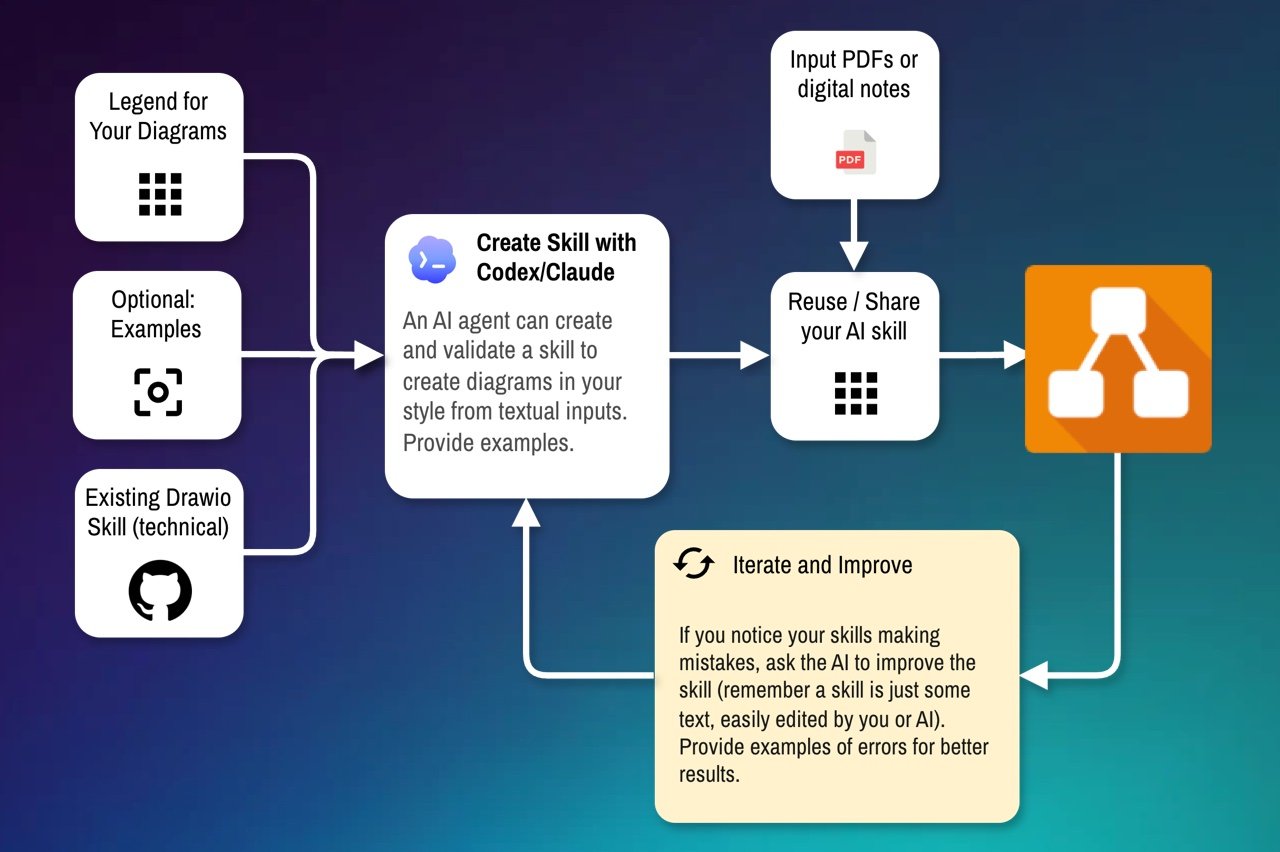
Using AI for academic writing has become ubiquitous, especially for non-native English speakers. Whether this will improve and democratise science or lead to more meaningless, sometimes factually wrong content (i.e. “AI slop”) is up to us. In this article, I want to dive deep into the main mistakes you want to avoid to create meaningful, concise and factual academic writing that you have full intellectual ownership of.
Learn which tools can speed up your research: This free 21-day email series introduces you to a range of academic tools and how they work together to speed up the time needed for a literature review. Most of these tools have been around for less than a few years, some use AI. Knowing them gives you an almost unfair productivity advantage for your research.
In my opinion, the state of AI writing is best described with the analogy of baking.
Bread consists primarily of flour and water, yet there are dozens of different styles of bread. Some are cheap and ubiquitous, some are expensive and exclusive. In most cases, the difference lies in the baker’s skill and the quality of the ingredients. How you knead the dough, at which temperature it rises and at which exact time you take it out of the oven, can make the difference between an artisanal loaf and a soggy supermarket baguette.
AI writing is just like this. If you know what you are doing and your inputs (i.e., prompts) have good quality, the AI output will be excellent. The changes you need to go from mediocre to excellent are often very small, but have massive impacts. Here are the Mistakes to avoid:
Mistake: Using AI without providing (a lot of) context
If you just ask ChatGPT to write a paragraph on your academic topic, the results will be well-written, but profoundly shallow. Anyone with some experience in your field will notice this instantly, which will discredit you. To avoid being generic, you need to provide AI with deep-information otherwise not easily available online:
- Papers, Presentations, Materials
- Drafts you have written
- Your own notes
Compare these two outputs:
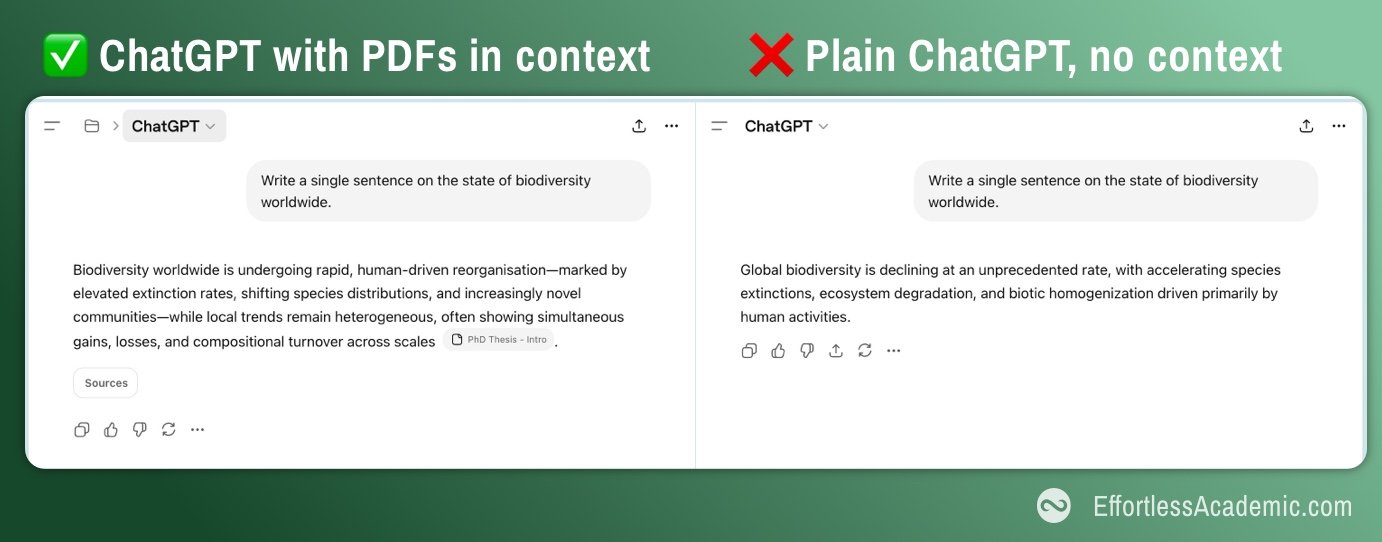
Now, both of them have AI ticks such as the ubiquitous em dash. The text on the right, without context, is also far more generic and, despite being factually correct, would require much more work to be used in academic writing. Moreover, the text on the left is a little bit more opinionated (e.g. the biodiversity reorganisation is human-driven, rather than just declining). Since the opinion comes from my own PhD thesis introduction (notice the reference to the context on the left), I support that standpoint, and it will therefore work better with anything that I write.
Technically, you can use custom GPTs, gems (if using Google), or ChatGPT projects to provide this context. I have an in-depth tutorial on creating CustomGPTs here. ChatGPT projects are a lightweight, quick-and-dirty version of CustomGPTs. You just create a new project and upload your PDFs to it, zero friction:
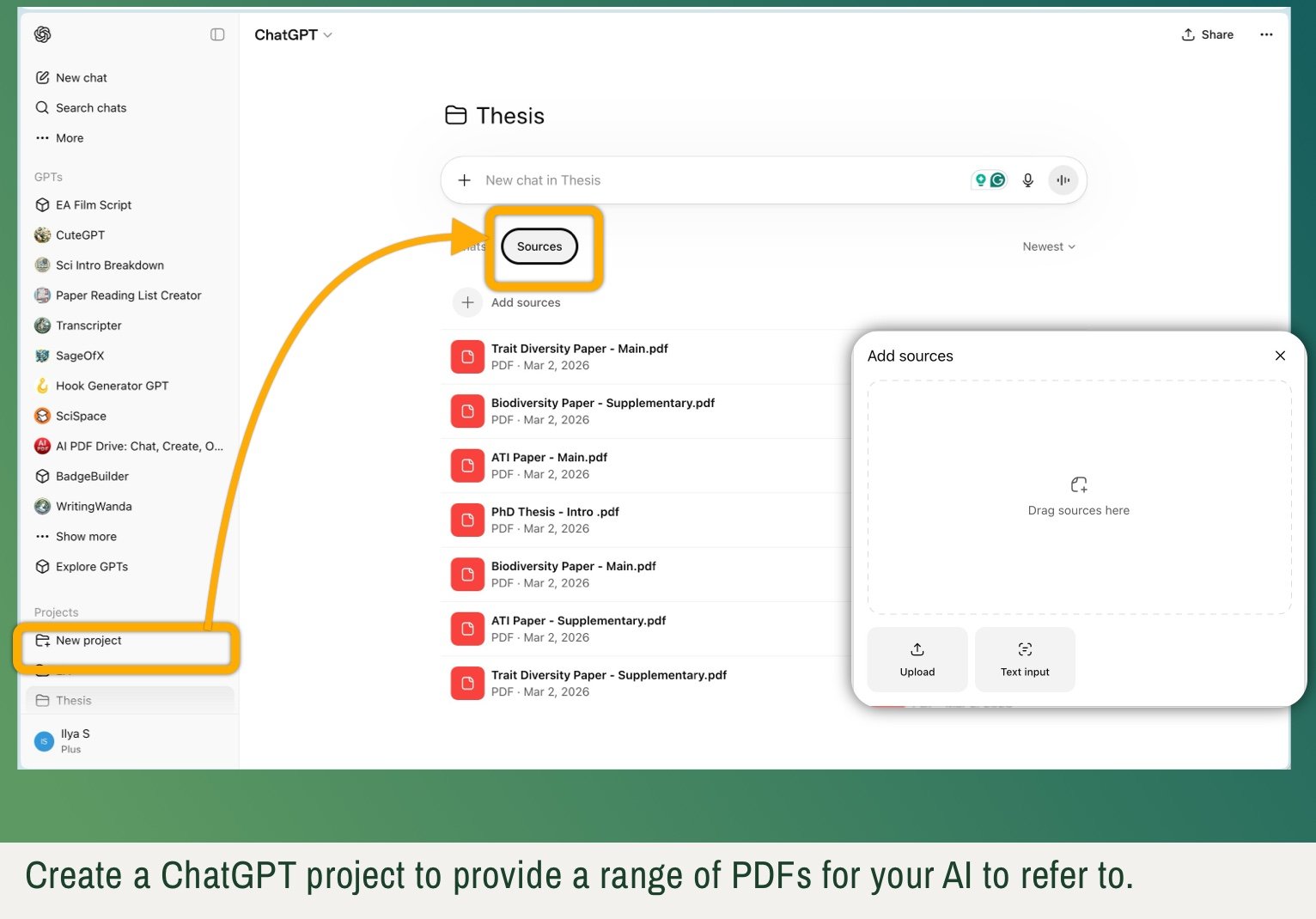
If you want your chat to refer to these PDFs, you can usually directly say so by using variations of the following prompts:
- [...] Use your knowledge base to answer this question.
- First, read the <Document>, summarise its main conclusion, then answer the following question [...]
- Think hard about your reply and refer to all uploaded documents for a precise answer.
However, keep in mind that the more PDFs you upload to the context, the less likely ChatGPT is to read them all. My suggestion, therefore, is to have separate projects for different parts of your writing. For instance, each paper could be its own writing. The context should be, in my opinion, contained in up to 10 PDFs. Anything about that will yield diminishing returns.
Mistake: Treating Every Part of the Paper as Equal
Different parts of the manuscript require very different skills and can be easier or harder to write with AI. The output also depends on the order in which you write your paper. For instance, creating an abstract after writing your paper is something AI can do incredibly well, even though you personally would want to do it first to set the outline for your paper. Remember the typical structure of a paper:
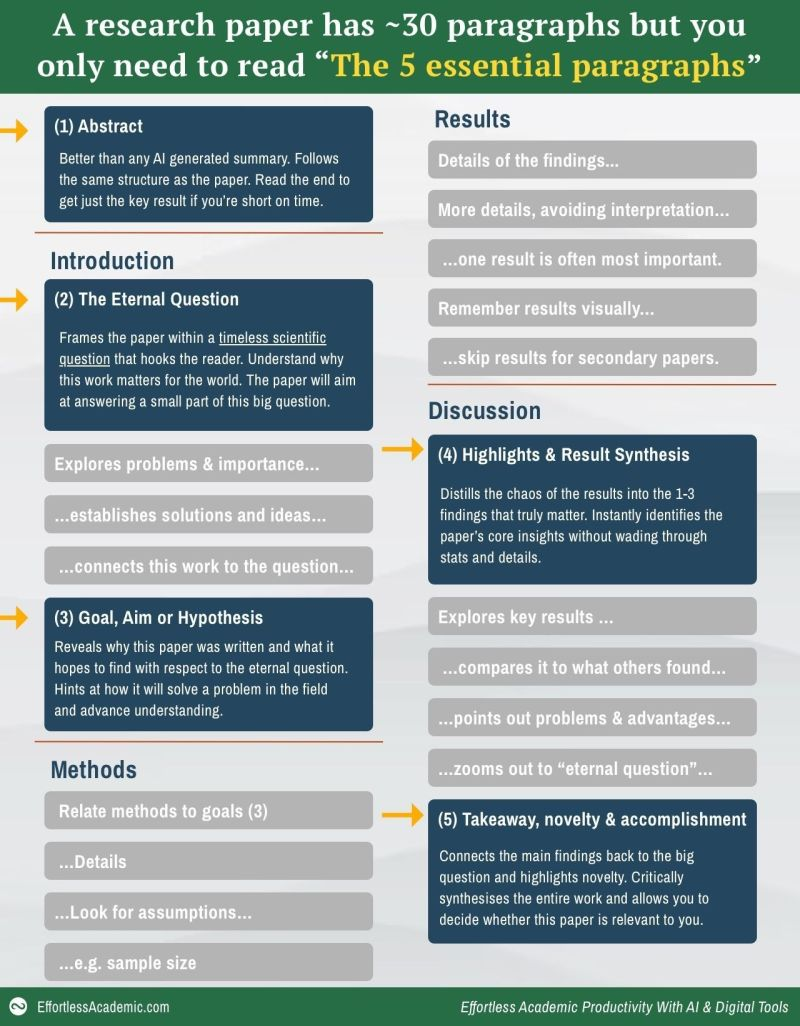
These are the paragraphs most suited for writing with AI:
✅ Abstract: If you have written your paper, the AI can generate a very good first draft for your abstract. It just needs a little bit of clarifying and polishing to be ready.
✅ First Discussion Paragraph: The first discussion paragraph often relies on the introduction and the results. If you have those written up, AI can give a wonderful first draft.
✅ Conclusion: Typically, the last paragraph of your paper, which summarises the main accomplishments in relation to the entire field of AI, has access to the entire paper as well as a few other PDFs that summarise the field. That can do a good job helping you write a first draft.
What doesn’t work:
❌ The “Here we…” paragraph (3): this one typically presents your novel ideas, and AI will generally not be aware of what you’re trying to do. This paragraph, by hand, to retain control of the narrative.
❌ Results: Any results paragraphs require an understanding of data plots and so on, which AI is currently not very good at. However, if you give AI single plots and ask for an interpretation, it can sometimes yield surprisingly interesting insights.
What may work:
🟡 Introduction: Introductions written with AI tend to be overly generic and shallow. Keep that in mind. However, if you iterate multiple times over the AI drafts and provide a lot of context for different paragraphs of your writing, AI can help you streamline your ideas and present them in proper academic English.
🟡 Discussion: Discussion paragraphs written with AI can often be factually incorrect or speculative, as the devil is in the details, and AI is not good at details.
Keeping these guardrails in mind, you can optimise your writing process to leverage the most out of AI by providing the right context at the right moment and by writing from detail to summary, so that AI can help you aggregate multiple detailed paragraphs into summaries and syntheses.
Mistake: You’re not telling AI how exactly to write
If you don’t customise how AI writes, most output will not meet academic writing criteria and have writing “ticks”, which easily expose it as AI-written even without AI-detectors. Here are the things you need to add to a prompt or instruction set for your AI to avoid:
- Teach AI to write in academic English by reverse-engineering academic papers or rules. Compress them into a single “academic writing prompt”. Here is a tutorial on making AI write in your own voice.
- Educate AI on how to structure paragraphs using a topic sentence, a conclusion, and specifying a length.
- Provide a list of not-gos for academic writing, such as the “em-dash”
Compare the results of these two prompts, one with custom instructions, one without:
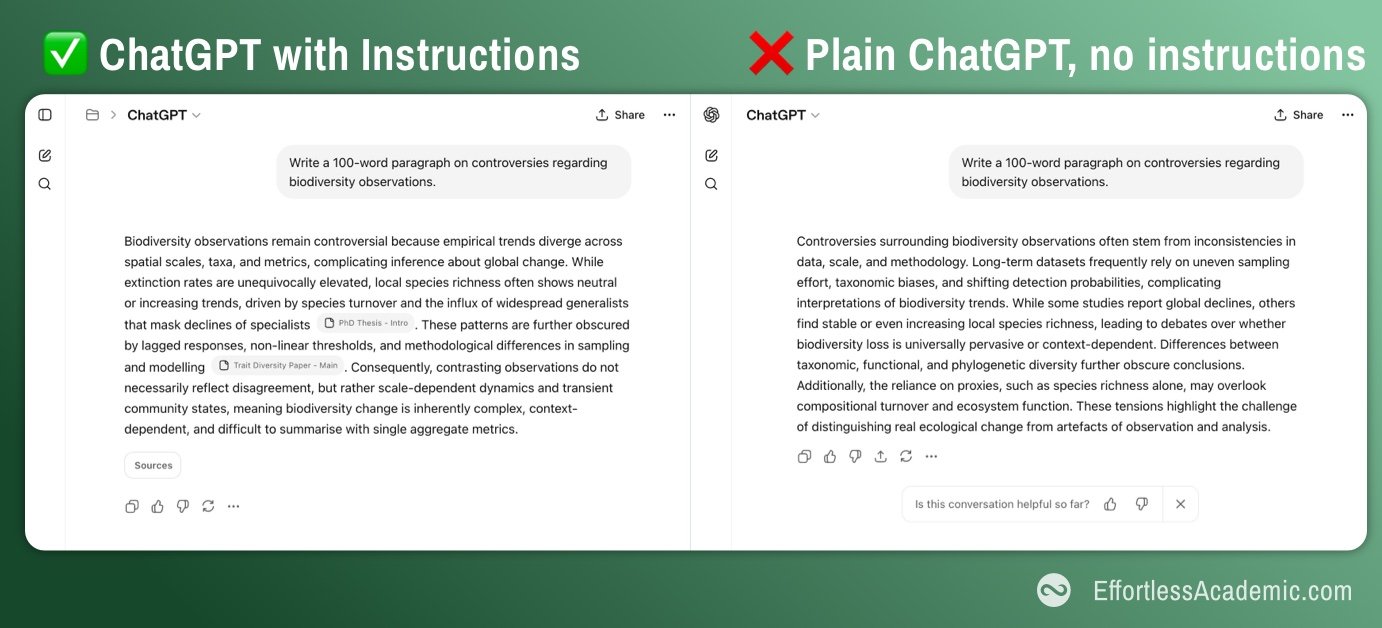
For example, the last sentence without instruction reads “These tensions highlight the challenge of…“, which is pretty generic. What is the opinion of the author? Why do we need to highlight this? Moreover, “tensions” is simply not the right word to use here, it sounds good, but is atypical in the literature.
While instructions and context PDFs force ChatGPT to write “contrasting observations do not necessarily reflect disagreement, but rather…“, which is far more opinionated and interesting.
Here is a prompt used as instructions to generate the left version of the text. You can add it to the ChatGPT project instructions or even just copy and paste them into the prompt itself:
Write for an ecologically educated academic audience while maintaining clear, simple sentence structure without unnecessary complexity, but using appropriate jargon.
1. Start paragraphs with a clear, an ambiguous, concise, and factually true topic statement.
2. Paragraphs mostly contain examples and follow a logical argument to support the topic statement.
3. Paragraphs conclude with the conclusion statement, which combines the original topic and the arguments and examples given into a definitive, meaningful and non-generic statement.
2. Ensure paragraphs are 150 to 200 words long.
Avoid these formulations:
- "It is not this, it's that"
- Use of Em dashes and semicolons, just use sentences.
- "Not only does this... it also does that..."
Mistake: Asking AI to write from scratch
Writing consists of two parts: The logical argument or narrative and the words you’re using to convey this argument. The strength of your writing lies primarily in the narrative, since the words you’re using can be easily edited. The narrative is something you have to deeply understand yourself, and that links your domain knowledge to the work you are trying to write.
Compare these two outputs, where I provide a bullet point narrative with referecesl on the left while allowing the AI to generically write on a specific topic:
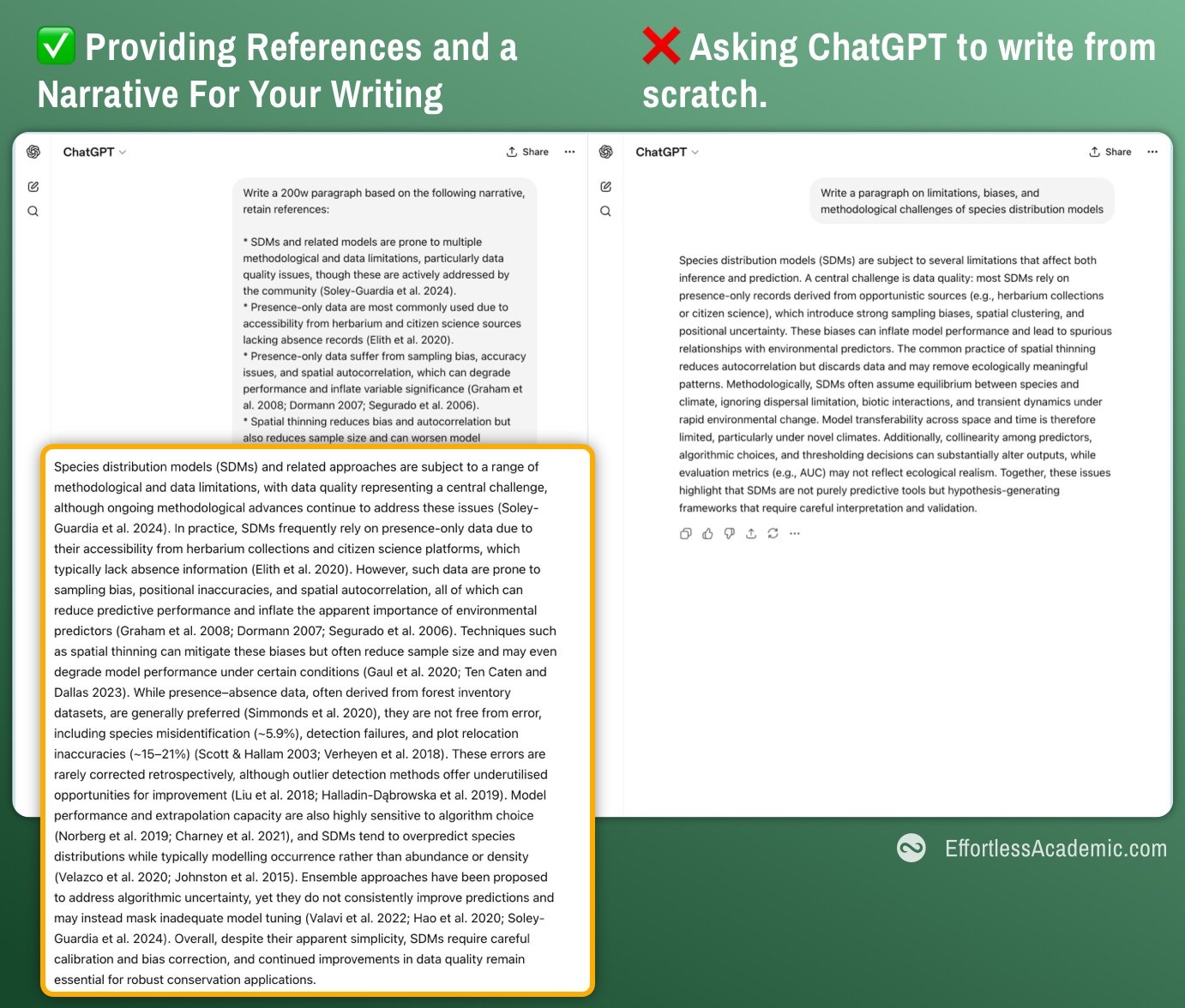
Notice how the paragraph on the left already contains all the references, the right points, in the right order, and reads like a usable academic first draft. The paragraph on the right is not wrong, but it will require a lot of work to be published.
I call this narrative-preserving method the “atomic statement method”. It is particularly powerful for introductions where you summarise parts of existing knowledge. Here is an in-depth tutorial.
Notice that the narrative bullet points can be very clumsily written and you can even write in your native language, rather than English. This will not greatly influence the results, as you separate the logic of your argument from the actual words that are needed to transmit that argument.
Senior academics will typically say that formulating an argument is a form of learning and understanding your subject and hence outsourcing it to AI is wrong. I partially agree, but I don’t think that the writing part has to happen during publication, but should instead happen when you take notes. This is why the effortless academic note-taking system relies on taking notes in your own words, rather than highlights in PDFs.
By the way, you can also constrain your AI writing in many ways. For instance, you can ask AI to keep the order of your bullet points or rearrange them. You can explicitly ask it to filter them and split up the content into multiple paragraphs if needed, playing around with how much control you relinquish to your narrative.
Mistake: Relying on AI to make an argument or draw conclusions
The most dangerous mistake you can make is to outsource logical reasoning to AI. Even if you guide it with atomic sentences and provide proper citations and context, it can still create conflicting results. Check out this example, where I ask AI to join 4 atomic sentences into a sentence:
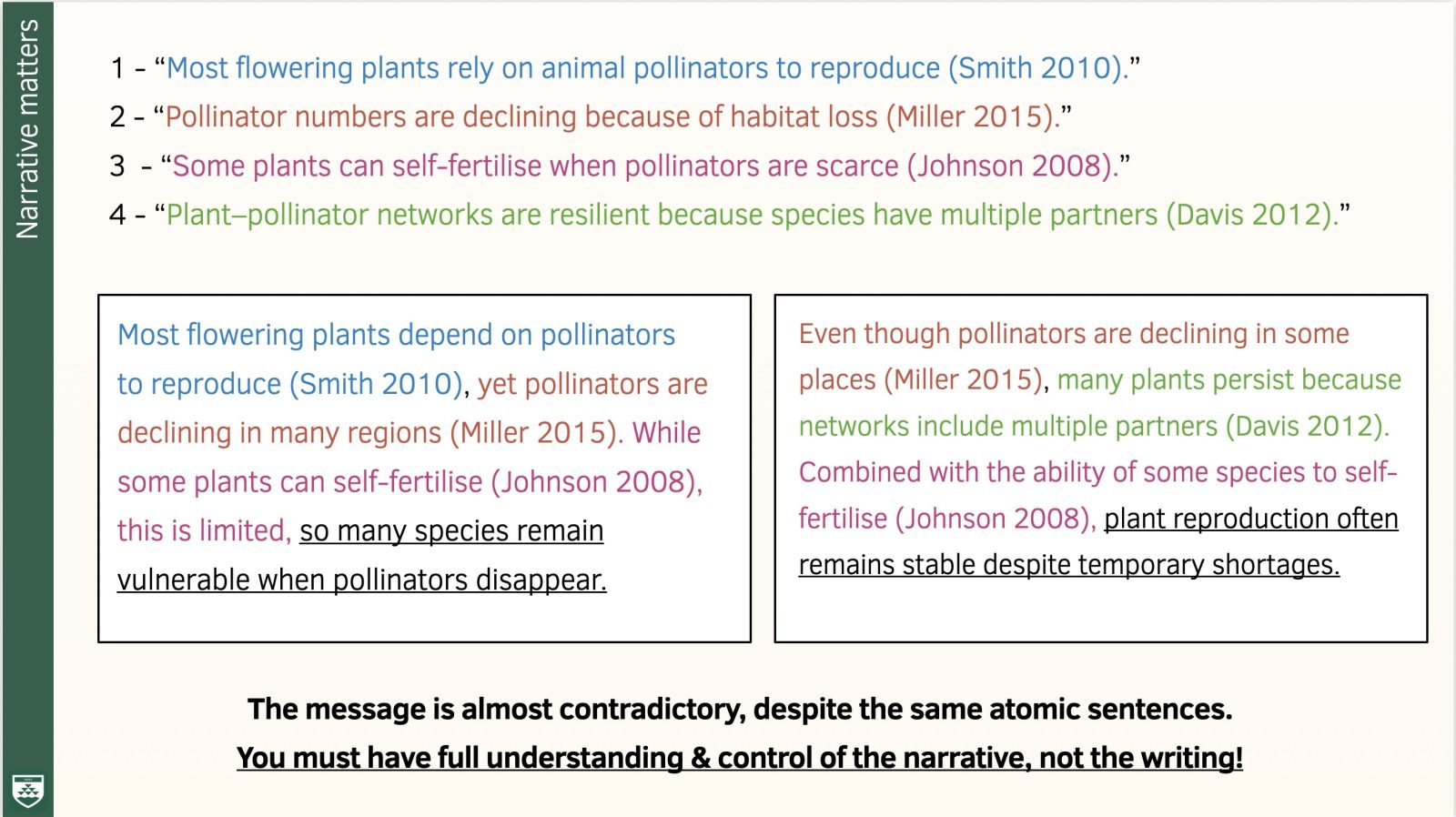
AI correctly uses the four sentences, but the message it sends is exactly contradictory. On the left, “species are vulnerable when their pollinators disappear”, while on the right, they “remain stable”. If you are not aware of these small nuances, the results for your academic writing can be catastrophic. Make sure to never rely on AI to make an argument or draw a conclusion.
Mistake: Asking AI for an opinion
Don’t ask AI for opinions or guidance. This should come from you, as you are otherwise reinforcing biases and setting yourself up for failure. The goal of any AI tool is to fulfil your request. This means that it will tend to agree with whatever opinion you are leaning towards. Check out this prompt I asked Consensus AI, which is otherwise the most truthful AI search engine:
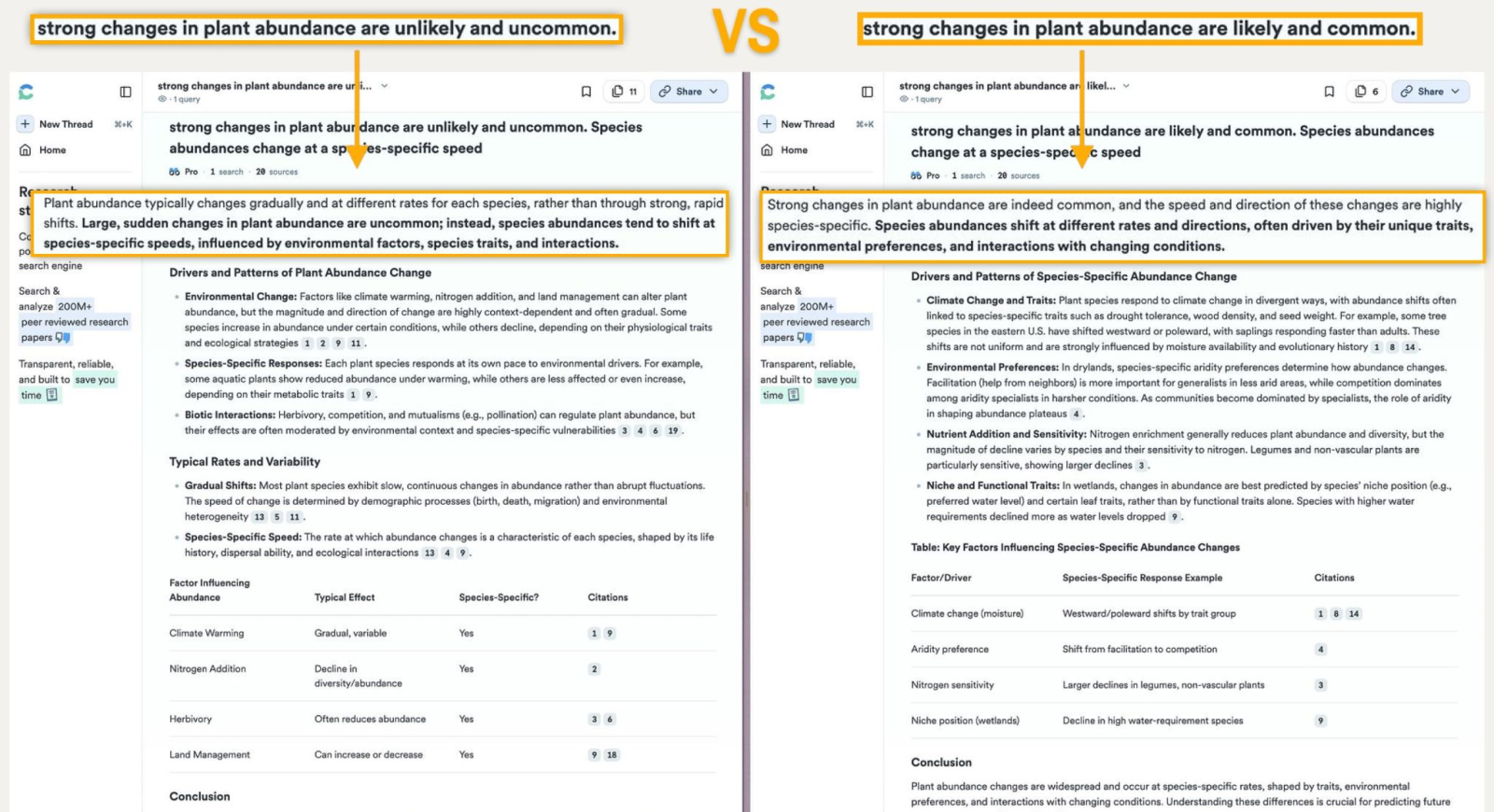
The prompts ask to find evidence of strong changes in plant abundance, which are “unlikely and uncommon” on the left or “likely and common” on the right. In both cases, AI agrees with me (!) but uses different papers to argue its argument. This, of course, reflects the controversies in the field, but, to a greater extent, it also exposes the problem of an AI that tries to be agreeable to me to avoid bias, yet can neglect facts.
Not editing AI output, or editing it only once
If you are copying and pasting AI writing, this might be a big concern for academic integrity. Since you don’t know where AI got the exact words from that it’s generating, you can even commit plagiarism without knowing that. The main strategy for mitigating this is to thoroughly edit whatever the AI has written multiple times and to come to a co-created paragraph. Here is an outline of my typical workflow for using AI to write.
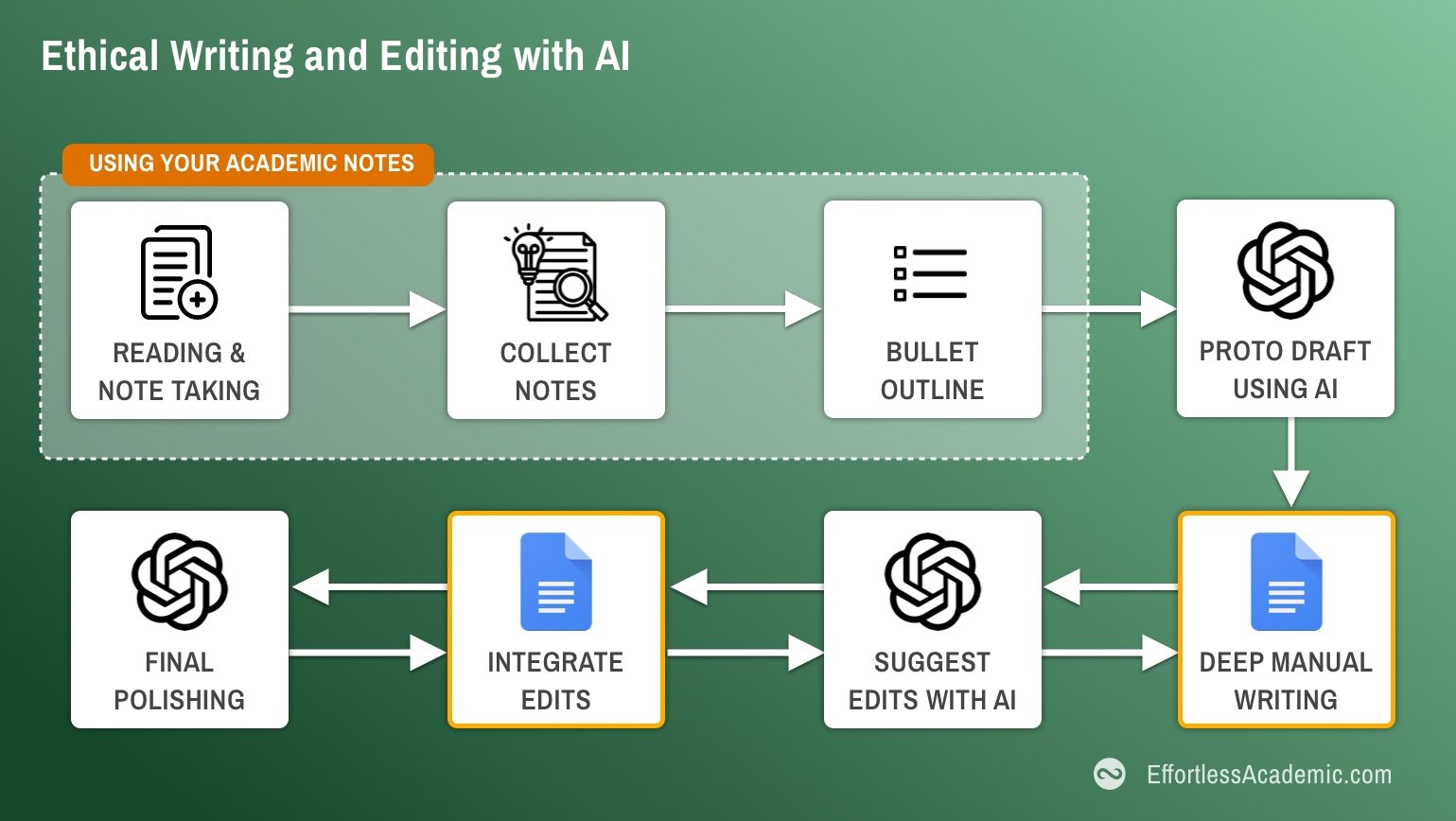
The key to success here is that everything is based either on my own notes or pdfs using the atomic sentence method. Then this writing is being processed, and then back and forth between me and the AI, ensuring that I control every word and that raw AI output never makes it into the final publication. Read more details on this method in this tutorial:
Mistake: Asking AI to just “polish writing”
While you might often ask AI to write something or improve something, your intention usually vastly differs. The more precise you can frame your request, the better the results will be. Compare these two prompts where I have a really poorly written run-on sentence that I want to improve with ChatGPT:
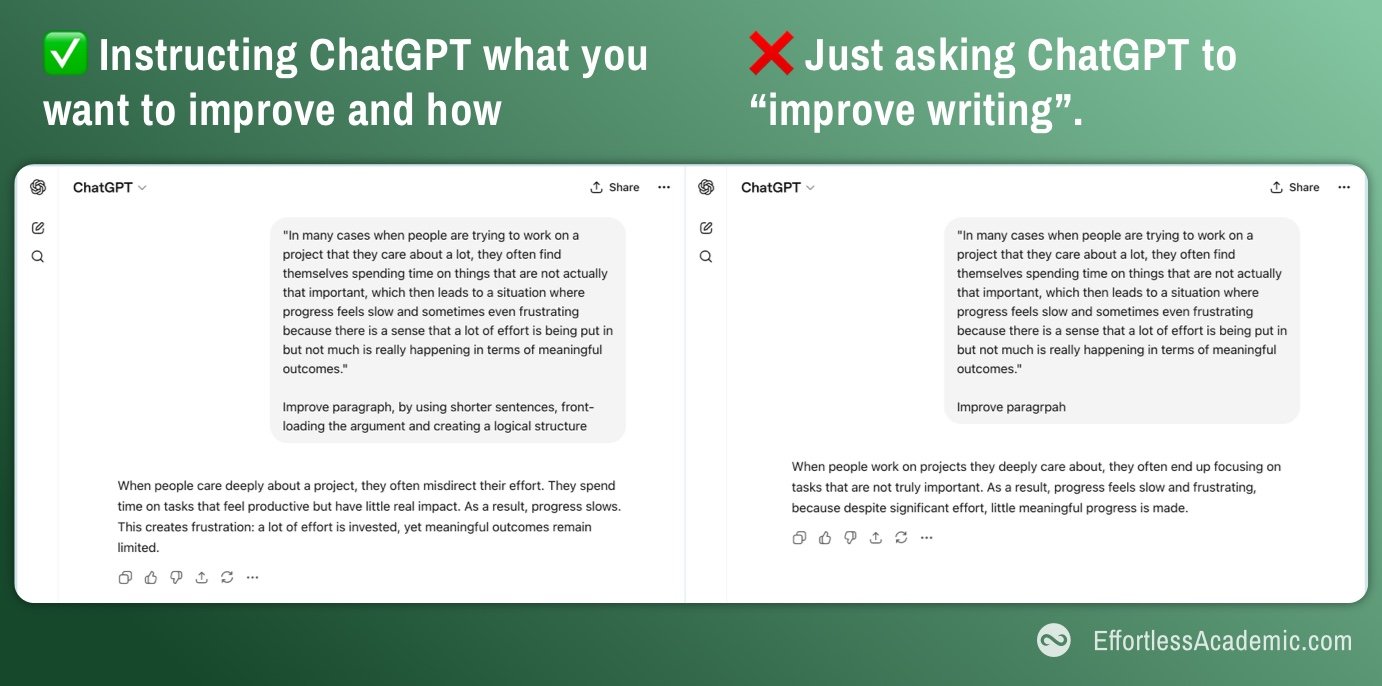
On the left, I specify how it should improve the paragraph “by using shorter sentences, front-loading the argument, and creating a logical structure“, on the right I just want to improve it, but haven’t thought about what is actually wrong.
Notice how much more concise and directed the opening sentence on the left becomes: “When people deeply care about a project, they often misdirect their effort,” rather than “[…] they often end up focusing on tasks that are not truly important.” They both convey the same meaning, but the sentence on the left is much more aligned with academic clarity and brevity, while the sentence on the right still remains somewhat generic.
When advising AI to improve my writing, here is the repertoire of prompts I typically use:
- “Join these ideas more fluently together, as the paragraph seems clunky.”
- “Break up run-on sentences to make the paragraph easier to read.”
- “Point out flaws in the structure of this paragraph and suggest how to fix them.”
- “Find redundancies in my paragraph and eliminate them.”
- “Point out ambiguities and replace them with more definitive statements.”
When trying to improve your text with AI, a few short words of guidance can make a massive difference in the output.
Exactly for that reason, you as a human should read a lot and to be aware of what good writing feels like, so that you can compare it to yours and help AI fix the difference.
Mistake: Not knowing what good academic writing looks like
If you don’t know what good academic writing looks like, start reading and taking notes.
There is absolutely no shortcut to learning this skill. However, just like a good restaurant critic doesn’t have to be a good cook, you don’t have to be an expert writer to notice what good writing feels like.
This is exactly what AI enables: creating great output just by precisely describing what you want, rather than doing it yourself. This is a fundamental mindset shift that many academics find challenging. In fact, I once did a social media post, which resulted in a shitstorm with 100s of hate comments precisely for that reason. Here is the story behind it:
AI will likely disrupt academic writing, but I think it’s difficult to tell what the finalresult will look like at this time. For me the trend seems to go towards the approach outlined here: Directing, guiding and failproofing AI writing, to maintain control of what you want to say, but not necessarily how you say it.
I encourage you to experiment and understand the limitations. Write down your learnings, such as the 11 academic writing lessons I learned, and keep up with technology to maintain your productivity.
Is AI Writing Detectable?
AI detectors are notoriously unreliable because of a fundamental problem: Good AI writing should be indistinguishable from human writing, but if this is true, human writing will be indistinguishable from AI writing, as well. Upload an academic paper that was written before AI started in 2023, and you’ll typically find that AI detectors suggest it was partially AI-written.
In my opinion, the AI detectors will be obsolete in the near future. What will count is the creativity of your ideas, not the eloquence of your words. Since Large Language Models are based on predicting the next word, they are, by definition, predictable. The more unpredictable and innovative your thoughts are, the more impact your writing will have, regardless of the words it uses to communicate.